The ambition to study usa programs is shared by millions of brilliant minds globally. However, the financial realities of an American education can often seem insurmountable. In 2026, the landscape of higher education funding has evolved, but the Massachusetts Institute of Technology (MIT) remains the gold standard for institutional generosity.
This comprehensive guide breaks down everything you need to know about MIT’s financial aid policies for 2026, while also exploring alternative usa university scholarships across the country. Whether you are seeking a bachelor’s degree or a scholarship for master degree in usa for international students, understanding the mechanics of these funding opportunities is the first step toward achieving your academic dreams.
Why MIT is the Ultimate Destination in 2026
For international students studying in the us, MIT represents more than just peak academic rigor; it represents pure financial equity. MIT is one of only nine American universities that is fully “need-blind” and “full-need” for all applicants, regardless of citizenship.
But what do these terms actually mean for international students us applicants?
-
Need-Blind Admissions: The admissions committee does not consider your ability to pay when deciding whether to admit you. Your financial background will never be a disadvantage during the us university admission process.
-
Full-Need Financial Aid: If you are admitted, MIT calculates exactly how much your family can afford to pay and covers 100% of the remaining cost. There are no partial scholarships here; they meet your entire demonstrated need.
For the 2026–2027 academic year, MIT’s total cost of attendance (including tuition, housing, dining, and personal expenses) is estimated at roughly $92,760. However, most us university students at MIT pay a fraction of this. In fact, for the 2026 cycle, students from families earning under $200,000 typically attend MIT completely tuition-free. If your family earns under $100,000, your expected parent contribution is exactly $0.
Because MIT does not award athletic or academic merit scholarships, every single dollar of their $176 million financial aid budget goes directly toward need-based american scholarships for international students. This makes MIT one of the most accessible institutions in the world—if you can secure a highly coveted acceptance letter.
The Broader Landscape of US University Scholarships
Because MIT admits fewer than 4% of its applicants, relying solely on this institution is not a viable strategy. Any expert in abroad university admission will advise you to build a balanced college list. Fortunately, there is a vast network of us universities offering scholarships to international students.
When researching a usa university for international students, it is crucial to understand the difference between need-based aid (like MIT’s) and merit-based aid. Many public institutions offer substantial merit funding to attract top global talent. If you are hunting for a university of usa scholarship, you must look closely at how each institution distributes its endowment.
Categorizing Institutional Aid
| Aid Type | Description | Best For |
| Need-Based Grants | Funds awarded strictly based on family income. Does not need to be repaid. | Students with excellent academic profiles but high financial need. |
| Merit Scholarships | Awarded for exceptional academic, artistic, or leadership achievements, regardless of income. | Top-tier performers looking at a wider range of public and private schools. |
| Departmental Awards | Specific scholarships for american universities tied to a particular major (e.g., Engineering, Humanities). | Students with a highly specialized academic focus. |
Securing comprehensive us uni scholarships requires meticulous research. While Ivy League and equivalent schools offer massive need-based grants, many public state universities offer incredibly competitive merit packages that can reduce tuition to near-zero.
Spotlight on the South: Expanding Your Search
While Boston and California often dominate the headlines, some of the most lucrative american universities scholarships are found in the American South and Midwest.
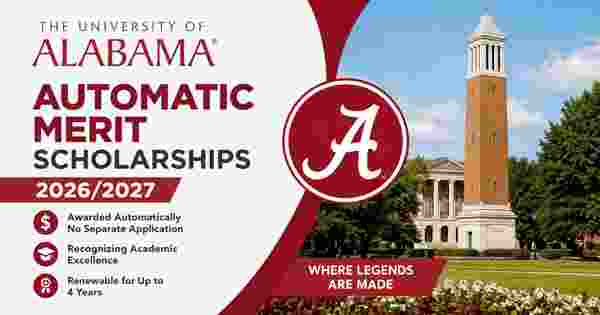
Take Alabama, for instance. Institutions here are aggressively recruiting global talent, and alabama scholarships have become some of the most generous merit-based packages in the nation. The state of alabama scholarships often include full-tuition waivers for international applicants who achieve specific SAT or ACT score thresholds.
Similarly, Historically Black Colleges and Universities (HBCUs) and other specialized technical schools are expanding their global reach. Institutions like North Carolina a and t university offer excellent research facilities and funding opportunities for STEM-focused scholars. For those who want the hustle of a major metropolis without the Ivy League price tag, new york city scholarships offered through the CUNY system or private liberal arts colleges in Manhattan and Brooklyn provide incredible value.
The Texas Advantage: A Hub for Global Talent
If you are serious about minimizing debt while maximizing career opportunities, you must look at Texas. The Lone Star State has engineered an educational environment that is highly favorable for united states international students.
The UT System and Beyond
The sheer volume of universities in texas for international students is staggering. A major draw is the state’s policy regarding competitive scholarship waivers: at many Texas public universities, if an international student receives a competitive academic scholarship of just $1,000, they are automatically granted a waiver that allows them to pay the much lower “in-state” tuition rate. This turns a standard award into a massive financial victory.
For those researching universities in texas usa for international students, the University of Texas system is paramount. ut scholarships (and the highly sought-after utexas scholarships at the Austin flagship) are incredibly competitive but deeply rewarding.
However, the real hidden gems are found slightly outside the capital. The Dallas-Fort Worth metroplex is booming. A notable fort worth texas university like TCU offers substantial aid, but the public research universities are where the volume lies.
Deep Dive: Arlington’s Educational Powerhouse
The University of Texas at Arlington is a prime example of an institution perfectly positioned for global scholars. Frequently searched online as uta university of texas arlington, uta university texas, or simply uta texas, this institution has built a reputation for massive research output and generous funding.
Whether you call it ut arlington university, uta arlington, or use casual local shorthand like uta uni and u of arlington, the financial reality remains the same: they offer outstanding merit packages. They are consistently ranked among the top universities offering scholarships in usa for engineering and nursing. Because the cost of living in Arlington is significantly lower than in Boston or New York, a partial scholarship here often goes much further than a full-tuition scholarship elsewhere.
Graduate Funding: Master’s and PhD Scholarships
The funding model shifts dramatically once you move past your undergraduate years. If you are seeking a scholarship for master degree in usa, the rules of the game change.
Unlike undergraduate programs where need-based aid reigns supreme, graduate funding is almost entirely merit and research-based. masters scholarship for international students in usa are typically not awarded through a central financial aid office, but rather directly by the academic department you are applying to.
Assistantships: The Engine of Graduate Study
For those hunting for a scholarship programs in usa for international students at the graduate level, your primary focus should be on Assistantships.
-
Teaching Assistantships (TA): You help professors teach undergraduate courses, grade papers, and run lab sessions. In exchange, the university waives your tuition and pays you a monthly living stipend.
-
Research Assistantships (RA): You work in a laboratory or research center assisting a professor with their grant-funded research. This also typically comes with a full tuition waiver and stipend.
For students conducting a rigorous study of us academic systems, it becomes clear that STEM master’s and Ph.D. programs are heavily funded by government and corporate research grants. Therefore, finding universities in usa for international students with full scholarship at the graduate level is less about applying for a traditional “scholarship” and more about networking with professors whose research aligns with yours.
Third-Party Funding and External Grants
Even if an institution provides us study scholarships, it rarely covers flights, visa application fees, or initial setup costs. To bridge the gap, students must look beyond institutional aid and seek out external american scholarships.
There is a vast ecosystem of private foundations, non-profits, and international organizations offering a scholarship for foreign students in usa. Programs like the Fulbright Foreign Student Program, the Aga Khan Foundation, and the AAUW International Fellowships provide millions of dollars annually.
When searching for a usa scholarships for international students, pay close attention to the eligibility criteria. Many of these funds are specifically designated for students from developing nations or for women in STEM. Furthermore, if you are an international student, you will be traveling on an F-1 visa. It is vital to seek out scholarships for f1 students in usa, as some domestic private scholarships require U.S. citizenship or a Green Card. Ensure that any usa scholarships you apply for explicitly state that international applicants are welcome.
Navigating the Application Process for 2026
Successfully securing us university scholarships for international students requires a timeline that begins at least 12 to 18 months before you intend to enroll.
Step 1: The CSS Profile
Unlike domestic students who use the FAFSA (Free Application for Federal Student Aid), international students applying for need-based aid at private institutions like MIT must use the CSS Profile. This is a highly detailed application managed by the College Board. It requires extensive documentation of your family’s income, assets, tax returns (translated into English), and living expenses. Be meticulously honest and thorough; schools use this data to calculate your exact financial need.
Step 2: The Admissions Essays
Your academic metrics (GPA, SAT/ACT, TOEFL/IELTS) only get your foot in the door. The deciding factor for elite international students usa applicants is the essay. Whether you are applying to MIT, a prestigious usa university scholarships program, or a competitive research fellowship, your personal statement must communicate your unique worldview, your resilience, and how you will contribute to the campus community.
Step 3: Proving Financial Viability for the F-1 Visa
To officially become part of the international students usa demographic, you must clear the final hurdle: the F-1 Visa interview. U.S. immigration law requires you to prove that you have enough liquid funds to cover your first year of study.
If you have secured a full-ride scholarship from MIT, the university will issue an I-20 form showing that your tuition and living expenses are 100% covered by the institution. This makes the visa process incredibly smooth. However, if you only secure partial study usa scholarships, you will need to provide bank statements proving your family or private sponsors can cover the remaining balance.
Conclusion
The journey to secure funding to study in the United States requires strategy, patience, and impeccable timing. While MIT represents the absolute pinnacle of need-blind, full-need financial support for global talent, it is just one piece of a massive educational puzzle. From the generous merit programs of the Texas university system to the specialized graduate assistantships scattered across the country, the opportunities are vast. By broadening your search, optimizing your application timeline, and understanding the distinct difference between need-based and merit-based aid, you can turn the dream of studying in America into a fully funded reality in 2026.